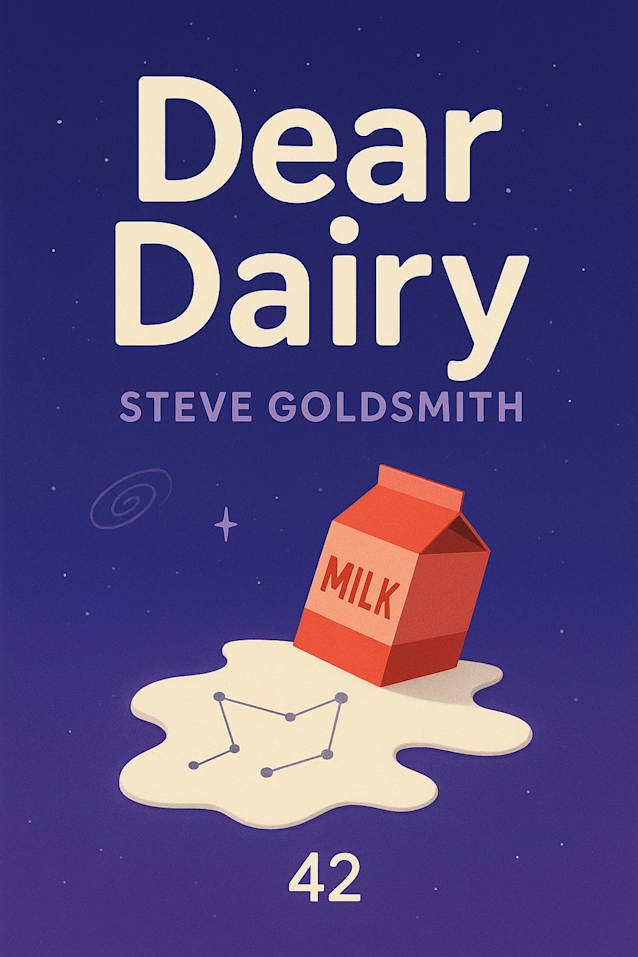
Dear Dairy: The True Dreams of Justin Case
About
Justin Case is twelve years old, mildly autistic, dyslexic, and wildly imaginative. His diary—sorry, dairy—is a sacred space where football stats meet spelling mantras, and dreams unfold with mathematical precision. Each night, Justin records a dream exactly 666 words long. Each morning, he wakes a little wiser.
From spelling bees to cafeteria rebellions, silent pilgrimages to pig-led revolutions, alien janitors to dream dictionaries, Justin’s dreams are flash fiction with heart. They span genres, challenge norms, and reveal a boy learning to navigate a world that doesn’t always understand him.
But Dear Dairy is more than a collection of dreams. It’s a love letter to neurodivergent minds, to the power of imagination, and to the invisible threads that bind us. It’s a story of becoming—of finding voice, finding connection, and finding peace.
Through 42 diary entries and 42 dreams, Justin’s journey unfolds with humor, honesty, and a voice you won’t forget. And when the final dream arrives, it will stay with you—long after the last page.
Perfect for fans of George Saunders, David Sedaris, and Jenny Lawson, Dear Dairy will make you laugh, wince, and remember the strange, electric truths of being twelve.
This is not just a coming-of-age story. It’s a coming-to-voice story.
And Justin Case has something to say.
Praise for this book
Quiet empathy is the first emotion this story awakened in me.
Not shock, drama, or sadness, but a gentle urge to protect this boy as he tries to understand the world.Justin’s voice is imperfect, honest, and vulnerable, and that combination creates an immediate sense of closeness. As the story unfolded, I found myself experiencing the world from his perspective.
After the initial empathy came a soft sadness, tenderness, a sense of loneliness, and warmth in the smallest moments. I simply wanted to understand him.
At first the book feels like an unusual diary written by a young boy, but soon it becomes clear that we are witnessing the formation of identity, the process of growing up, and an attempt to understand the world from within. His dreams process fears, loss, trauma, and questions he cannot yet express directly.
Family tensions, loss, and violence shape his inner life, and the author presents this without dramatization, which made it even more affecting for me.
Mandy becomes a point of light in his world. She does not pity him. She understands him. Their connection brings a powerful theme of acceptance.
Later chapters open philosophical questions about God, purpose, guilt, and the personal path without imposing answers.
Justin’s neurodivergence is not portrayed as a problem, but as a different way of perceiving the world. That is one of the most beautiful messages of this book.
Thank you, Steve, for showing that being different is not a flaw.